


TutorCruncher is a powerful platform, but it’s not the perfect fit for every tutoring business. You might be searching for the best alternatives to TutorCruncher because you need advanced multi-branch management, more flexible payroll options, or an AI-powered scheduler that eliminates booking errors. The right software can reduce admin time by 60%, freeing you to focus on growth.
This guide analyzes the top platforms for tutoring centers, language schools, and test-prep academies managing 5 to 100+ teachers. We move beyond generic feature lists to provide a practical breakdown of each alternative, assessing its unique strengths, real-world limitations, and ideal customer profile.
For each platform reviewed, you will find:
- Key features and what they mean for your daily operations.
- An honest assessment of strengths and weaknesses.
- A clear overview of their pricing models.
- Practical migration considerations if you're switching systems.
- A concise, one-line summary of why and when to choose it.
Our goal is to give you the insights needed to select a system that not only solves current administrative headaches like double-bookings and manual invoicing but also scales with your business's future growth. This resource includes screenshots, direct links, and a final comparison table to help you make an informed decision.
1. Tutorbase
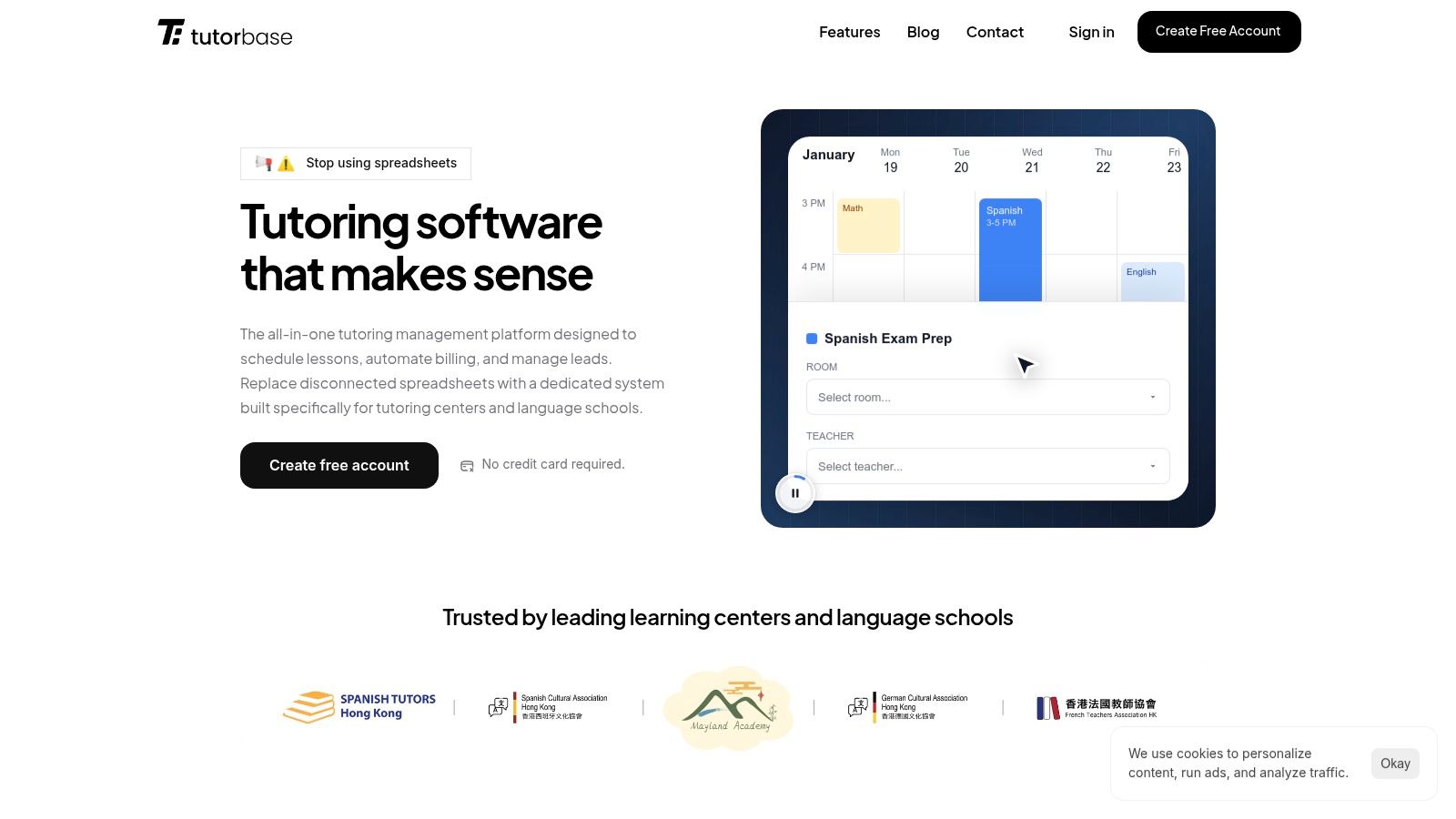
Tutorbase is an AI-powered management platform designed to replace fragmented tools like Google Calendar, QuickBooks, and Excel. It is a powerful alternative to TutorCruncher, engineered for growing tutoring centers, multi-branch operators, and language schools that need to automate complex operational workflows and reduce admin time.
Its core strength lies in intelligent automation. The AI-powered "Find Slot" feature generates optimized teacher, room, and time combinations for new bookings, reducing scheduling time from over 10 minutes to under 2. The platform automates the entire financial cycle, from generating invoices based on attendance to processing complex payroll with multiple pay rates and premiums. This comprehensive approach eliminates manual data entry and costly errors.
Why Tutorbase Stands Out
Tutorbase is built to handle scale. Its architecture supports multi-branch and even multi-brand operations from a single dashboard, a critical feature for expanding educational businesses. It centralizes everything from room management and lead capture (including a unique WhatsApp widget) to complex pricing policies and hybrid class management. This focus on operational efficiency is validated by client metrics, such as a 60% reduction in admin time and zero double-bookings.
Key Features and Use Cases
- AI-Powered Scheduling: The "Find Slot" and "Find Spot" tools instantly find the best options for new lessons or open seats in existing groups. Ideal for front-desk staff needing to onboard students 3x faster without cross-referencing calendars.
- Fully Automated Billing: Invoices generate automatically from attendance data with support for prepaid credits and packages. Perfect for centers that bill based on consumed lessons, turning hours of invoicing into minutes.
- Complex Payroll Engine: Supports diverse pay structures like revenue-sharing, base-plus-variable rates, and overtime premiums. This is a major advantage for centers with varied teacher contracts.
- Multi-Location & Room Management: Manage teachers, rooms (with capacity and fees), and branding across several branches from one account. Essential for franchise operators or regional academies.
Pricing and Onboarding
Tutorbase does not list public pricing. Access requires scheduling a demo for a custom quote, suggesting a focus on tailored solutions for mid-sized to large centers with complex needs. The platform is feature-rich, so businesses should anticipate an implementation period to migrate data and fully leverage its capabilities.
Why choose Tutorbase? Choose it when your primary challenge is operational complexity and a high administrative burden. It excels at automating scheduling, billing, and payroll for multi-teacher or multi-location tutoring businesses looking to scale efficiently.
Website: https://tutorbase.com
2. Teachworks
Teachworks is a long-standing and trusted tutoring management platform, particularly well-regarded among K-12 tutoring businesses, test prep centers, and language schools. It offers a comprehensive suite of tools designed to streamline core administrative tasks, from scheduling and attendance to invoicing and payroll. The platform's defining feature is its usage-based pricing, which can be particularly appealing for businesses with fluctuating lesson volumes.
As a TutorCruncher alternative, Teachworks stands out for its predictable and scalable cost model. Instead of per-user fees, its pricing combines a flat monthly fee with a small per-lesson charge. This structure ensures your costs align directly with your business activity, making it a budget-friendly option for centers with part-time staff or seasonal fluctuations.
Ideal For
Teachworks is an excellent fit for small to medium-sized tutoring centers (5-30 teachers) that need a robust, all-in-one solution without a complex feature set they won’t use. Its multi-location support also makes it viable for growing businesses managing a few branches.
Strengths & Weaknesses
Pros:
- Cost-Effective Scaling: The per-lesson pricing model means you only pay more as your business actively grows and delivers more lessons.
- Comprehensive Core Features: It reliably covers all the essentials: scheduling, automated invoicing, online payments, and payroll calculations.
- Transparent Pricing: The website features a clear pricing calculator, allowing you to estimate costs accurately.
Cons:
- Forecasting Complexity: While cost-effective, the per-lesson fee can be harder to forecast for very large centers with high lesson volumes compared to a flat subscription.
- Dated CRM Tools: Lacks some of the more advanced lead management and CRM features found in newer, more sales-focused platforms.
Website: https://teachworks.com/
3. Teach ’n Go
Teach ’n Go is a cloud-based student information system (SIS) and management tool popular among language schools and growing tutoring centers. Its main value proposition is simplicity and completeness. Unlike platforms that gate features behind higher tiers, Teach ’n Go includes its full feature set on all plans, with pricing that scales based on the number of active students. This makes it an accessible and powerful TutorCruncher alternative for businesses that need comprehensive functionality without complex pricing.
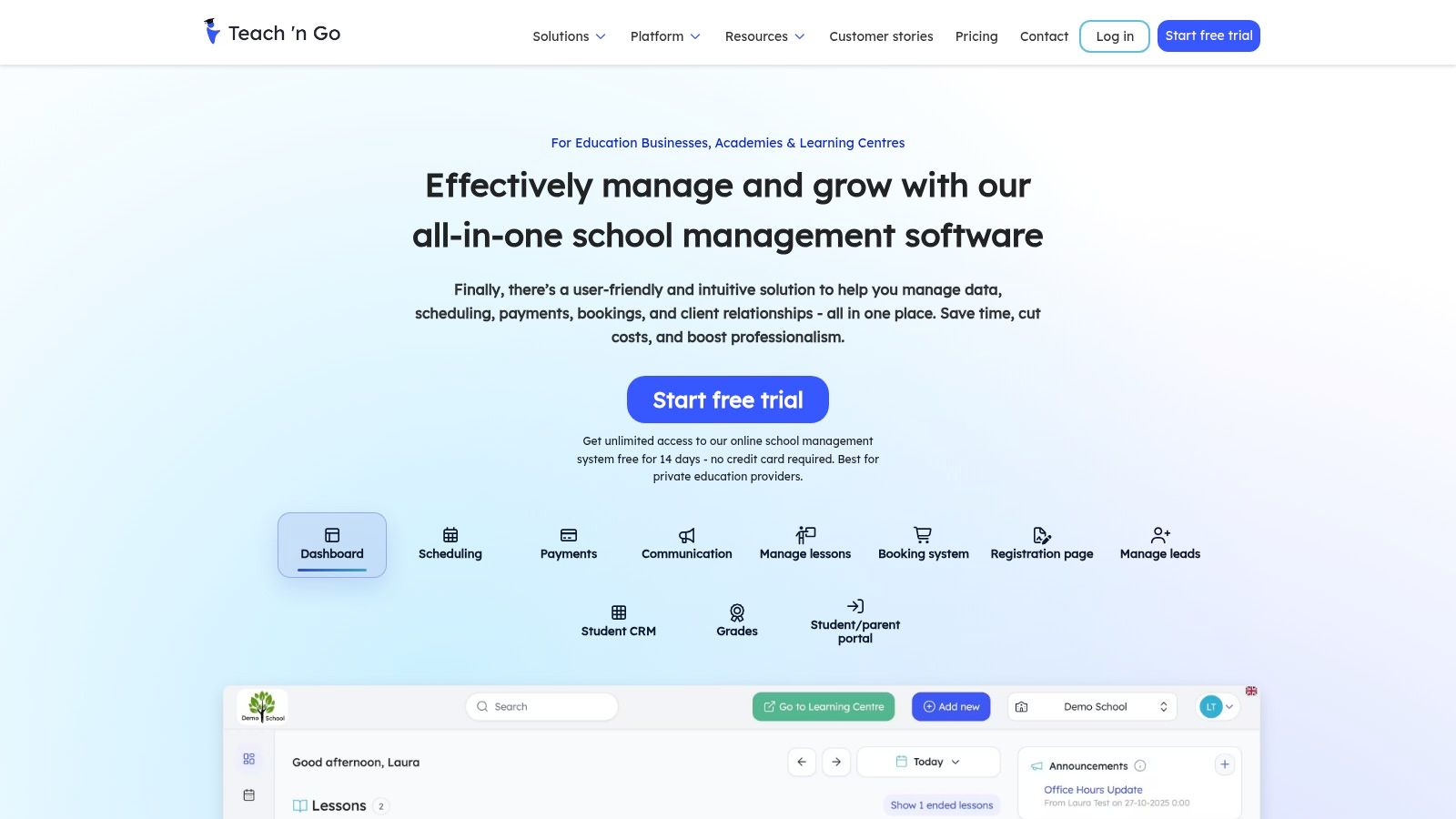
The platform is designed for straightforward operation, featuring a clean user interface and a dedicated mobile app for staff, parents, and students. With unlimited teacher accounts, group communication tools, and support for over 24 languages, it’s particularly well-suited for international or multilingual learning environments. Its focus on providing all tools to all users from the start removes guesswork and ensures businesses have the resources they need to grow.
Ideal For
Teach ’n Go is a great choice for language schools, international schools, and small to medium-sized tutoring businesses (10-50 teachers) that prioritize an all-inclusive feature set and straightforward, student-based pricing. Its multi-language support and clean mobile app also make it a strong contender for centers serving diverse communities.
Strengths & Weaknesses
Pros:
- All-Inclusive Features: Every plan includes the complete feature suite, so you never have to upgrade just to unlock a specific tool.
- Transparent Scaling: Pricing is based on active student count, making it easy to predict costs as your school enrolls more learners.
- User-Friendly Mobile App: The dedicated app for families and staff enhances communication and provides easy access to schedules and updates.
Cons:
- Student-Based Pricing: While transparent, this model can become less cost-effective for centers with a very high volume of students taking only a few lessons each.
- Geared Towards EUR: The pricing page defaults to Euros, which requires an extra step for USD-based businesses to see relevant costs.
Website: https://www.teachngo.com/
4. LearnSpeed
LearnSpeed is a specialized tutor management software designed with the operational needs of tutoring and test prep companies in mind. It provides a focused set of tools covering scheduling, invoicing, and detailed session reporting. The platform's most distinctive feature is its purely usage-based pricing, charging a small fee per session rather than a monthly subscription or per-user fee.
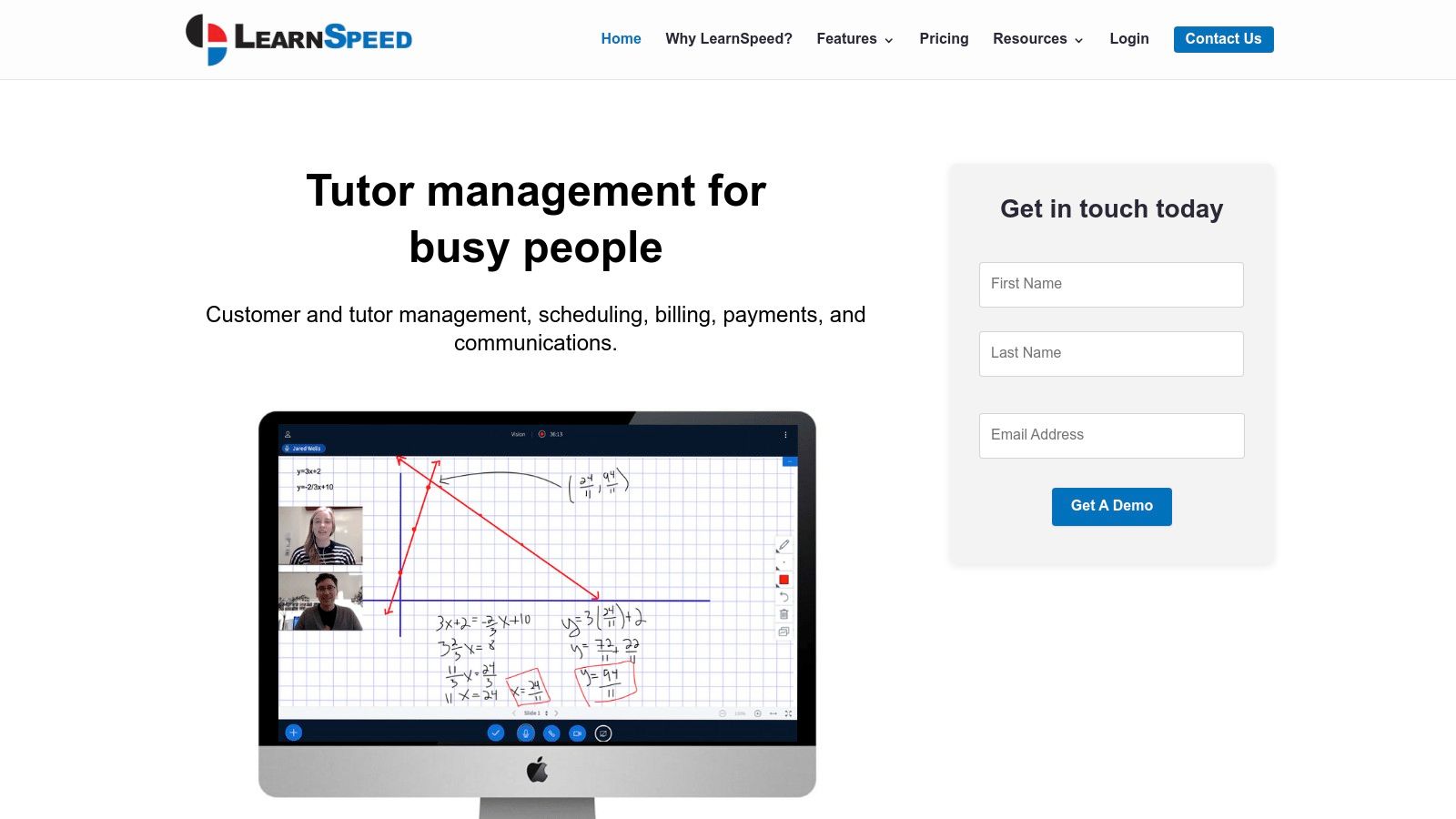
As one of the best alternatives to TutorCruncher, LearnSpeed appeals to businesses seeking ultimate cost flexibility. The pay-per-session model ($0.29 per session at the time of writing) ensures that operational costs are directly tied to revenue-generating activities. This can be particularly advantageous for businesses with inconsistent scheduling, such as those that are busy during the school year but quiet during holidays. The platform also includes a native online tutoring tool called "Vision" and integrates with QuickBooks for streamlined accounting.
Ideal For
LearnSpeed is a strong choice for small to medium-sized test prep centers and academic tutoring businesses that prioritize low overhead and predictable, activity-based costs. Its straightforward functionality is well-suited for owner-operators who need reliable core features without the complexity of an enterprise-level system.
Strengths & Weaknesses
Pros:
- Simple Per-Session Pricing: The transparent, pay-as-you-go model is easy to understand and eliminates fixed monthly costs, making it budget-friendly.
- Robust Reporting: Offers extensive reports on sessions, instructor feedback, and student progress, providing valuable business insights.
- Flexible Billing & Payroll: The system is built to handle various billing and payroll configurations, adapting to different business needs.
Cons:
- Cost for Group Sessions: The per-session model can become less cost-effective for large group classes where a single session involves many students.
- Billing Process: Some anecdotal user reports mention occasional friction or a learning curve in the billing and invoicing workflow.
Website: https://www.learnspeed.com/
5. TutorBird
TutorBird is a highly popular all-in-one management tool, particularly favored by solo private tutors and small-to-medium-sized tutoring centers. It delivers a streamlined and user-friendly experience, focusing on core administrative functions like scheduling, automated invoicing, and parent communication. The platform's main appeal lies in its affordability and straightforward feature set, which centralizes daily operations without overwhelming users with complex tools.
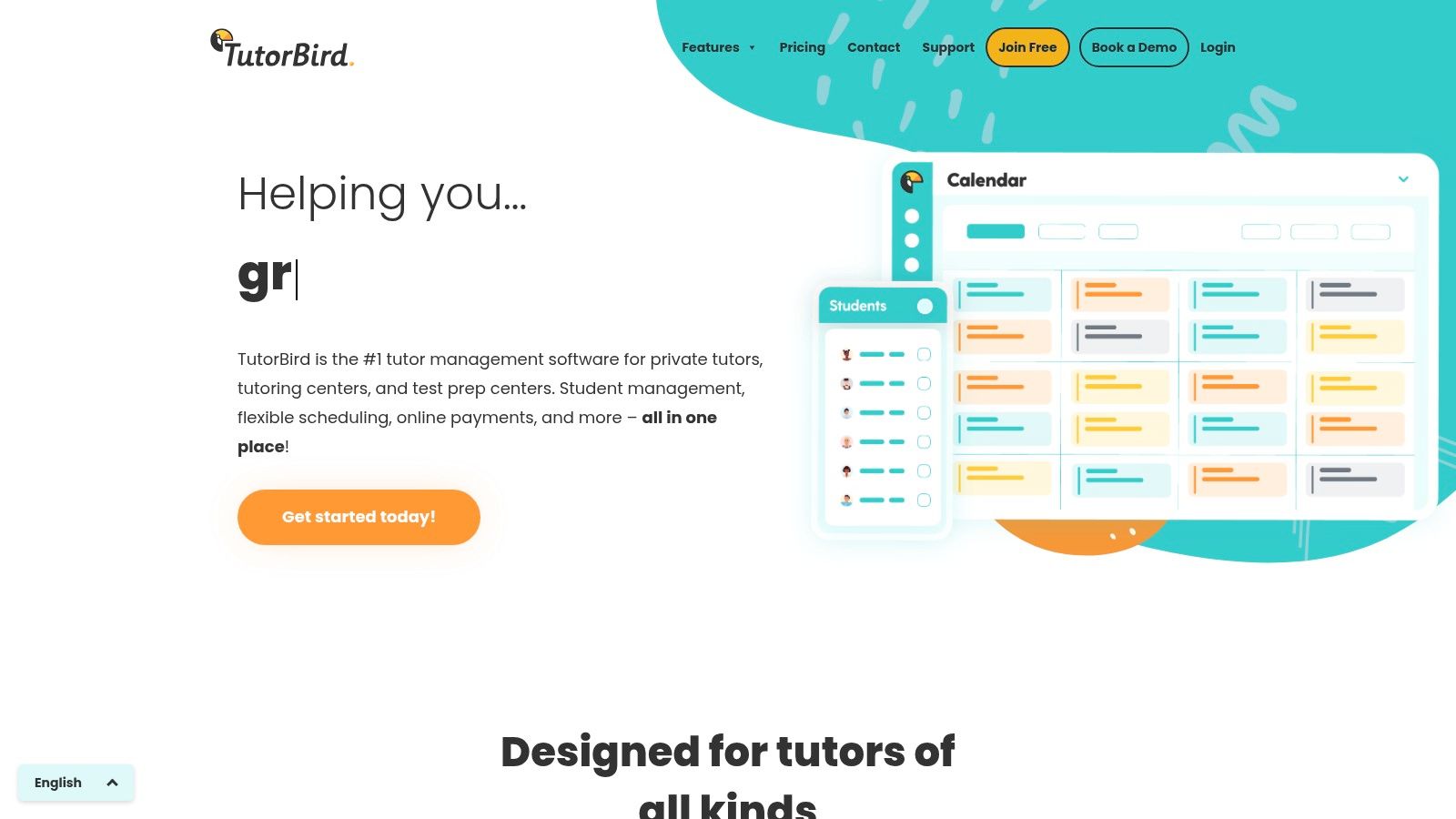
As one of the best alternatives to TutorCruncher, TutorBird shines with its very low entry price and generous trial period. While TutorCruncher caters to larger, more complex operations, TutorBird offers an accessible, out-of-the-box solution that effectively automates the most time-consuming admin tasks. Its simple website builder is a unique bonus for tutors who need a basic online presence without the hassle of a separate web development project.
Ideal For
TutorBird is perfect for individual tutors scaling their business or small tutoring centers (up to 20 teachers) that need an affordable, easy-to-use system. It excels for businesses where a single owner or manager handles most of the administrative workload and requires a reliable tool to manage scheduling, billing, and communication efficiently.
Strengths & Weaknesses
Pros:
- Highly Affordable: The base price is exceptionally low, making it accessible for solo tutors and businesses with tight budgets.
- Generous Trial: Offers a 30-day free trial and a 90-day money-back guarantee, allowing for a risk-free evaluation.
- All-in-One Simplicity: It effectively bundles scheduling, invoicing, payments, a student portal, and even a simple website builder into one easy-to-navigate platform.
Cons:
- Limited Scalability: The feature depth is geared toward smaller operations. Advanced multi-branch management for room and resource booking is limited.
- Basic CRM: While it manages student information well, it lacks the sophisticated lead management and sales pipeline tools found in more advanced systems.
Website: https://www.tutorbird.com/
6. Jumbula
Jumbula is a versatile registration and program management software tailored for businesses running classes, camps, and after-school programs. While not exclusively a tutoring platform, its robust enrollment tools make it a strong contender for seasonal providers like test prep academies or summer learning centers that manage high-volume, short-term sign-ups. The platform’s core strength lies in its customizable registration forms and payment processing.

As one of the best alternatives to TutorCruncher for program-based businesses, Jumbula excels with its flexible pricing. It offers both traditional monthly subscriptions and a unique pay-as-you-go model where you purchase enrollment credits. This is ideal for seasonal operations that don't want to pay a high monthly fee during off-peak months. Its embeddable widgets and branded registration pages help create a seamless sign-up experience directly from your website.
Ideal For
Jumbula is best suited for tutoring centers that operate like class-based programs, such as SAT/ACT prep courses, summer camps, or after-school clubs. Its pay-as-you-go model is perfect for businesses with significant seasonal fluctuations in enrollment, allowing costs to scale directly with revenue.
Strengths & Weaknesses
Pros:
- Flexible Pricing: The option for pay-as-you-go enrollment packs or monthly bundles caters to both seasonal and year-round businesses.
- Powerful Registration Tools: Offers highly customizable forms, discount codes, and embeddable website widgets for a professional enrollment process.
- Nonprofit Discounts: Publicly offers discounts for nonprofit organizations, making it an accessible option for community-focused education providers.
Cons:
- Add-On Costs: Key features like a dedicated business mobile app, advanced email/SMS marketing, and API access are priced as separate add-ons.
- Not Tutoring-Specific: Lacks some of the niche features for one-on-one tutor matching and complex payroll found in dedicated tutoring software.
Website: https://jumbula.com/
7. Sawyer for Business (Hisawyer)
Sawyer for Business is a specialized class and camp management platform designed for children's activity providers. While not a traditional one-on-one tutoring platform, it excels in managing group-based learning like after-school programs, art classes, and seasonal camps. Its core value proposition lies in its powerful consumer-facing marketplace and embedded checkout widgets, which help businesses attract and convert new customers directly.

As an alternative to TutorCruncher, Sawyer is best suited for organizations whose primary business model is group classes rather than individual tutoring. It simplifies the entire customer journey from discovery on its marketplace to registration and payment. The platform's fee structure is also distinct, as it applies booking fees directly to customer orders, which can be a double-edged sword depending on your client base's price sensitivity.
Ideal For
Sawyer is perfect for after-school program coordinators, summer camp organizers, and providers of enrichment classes (e.g., art, music, STEM) who prioritize marketing reach and a seamless booking experience for parents. It’s less suitable for academic tutoring centers focused on personalized, one-on-one instruction.
Strengths & Weaknesses
Pros:
- Large Marketplace Reach: Listing on the Sawyer marketplace can significantly boost visibility and attract new families.
- Embedded Checkout: Website widgets provide a smooth and professional registration process for parents.
- Transparent Fee Structure: The platform is very clear about its booking fees and how they are presented to customers during checkout.
Cons:
- Customer-Facing Fees: The non-refundable booking fee ($1.99–$3.99 per transaction) is passed on to your customers, which may deter some parents.
- Feature Gating: Key features, such as support for custom payment methods, are only available on more expensive plans.
Website: https://www.hisawyer.com/for-business
8. iClassPro
iClassPro is a powerful class management platform originally designed for activity-based businesses like gymnastics, swim schools, and dance studios. However, its robust features for group scheduling, camp management, and point-of-sale transactions make it a surprisingly effective alternative for certain types of tutoring centers, particularly those running large group classes, after-school programs, or seasonal camps.

As an alternative to TutorCruncher, iClassPro excels in managing high-volume, group-based enrollments. Its strengths lie in features that academic-focused platforms often lack, such as a built-in Point of Sale (POS) system for selling materials and branded mobile apps for enhanced parent communication. Its per-location pricing model is also attractive for businesses with a high number of part-time instructors at a single site.
Ideal For
iClassPro is best suited for large, single-location tutoring academies, after-school programs, and test-prep centers that operate primarily with group classes and camps. Businesses that need integrated POS functionality or want a branded mobile app will find it particularly compelling.
Strengths & Weaknesses
Pros:
- Strong Group/Camp Management: The platform is purpose-built for managing complex class schedules, enrollments, and multi-day camps.
- Integrated POS: The built-in Point of Sale system is a major advantage for centers that sell books, supplies, or merchandise.
- Advanced Communication: Offers robust tools like SMS and voice broadcasting to keep parents informed at scale.
Cons:
- Non-Academic Terminology: The interface and feature set are geared towards sports, so terms like "athlete" or "skill tracking" may require mental adjustment for academic use.
- Add-on Costs: Key communication features like SMS and voice messages are priced separately as credits, which can increase the monthly cost.
- Less Suited for 1-on-1: While possible, the workflow is heavily optimized for group classes, making it less intuitive for purely one-on-one tutoring models.
Website: https://www.iclasspro.com/
9. Pike13
Pike13 is a versatile business management platform originally designed for appointment-based businesses like gyms and studios, which has found a strong following among music schools and tutoring centers. It offers a robust feature set covering scheduling for classes and appointments, sophisticated billing, payroll processing, and client management. Its standout offerings include branded mobile apps and extensive website integration widgets.
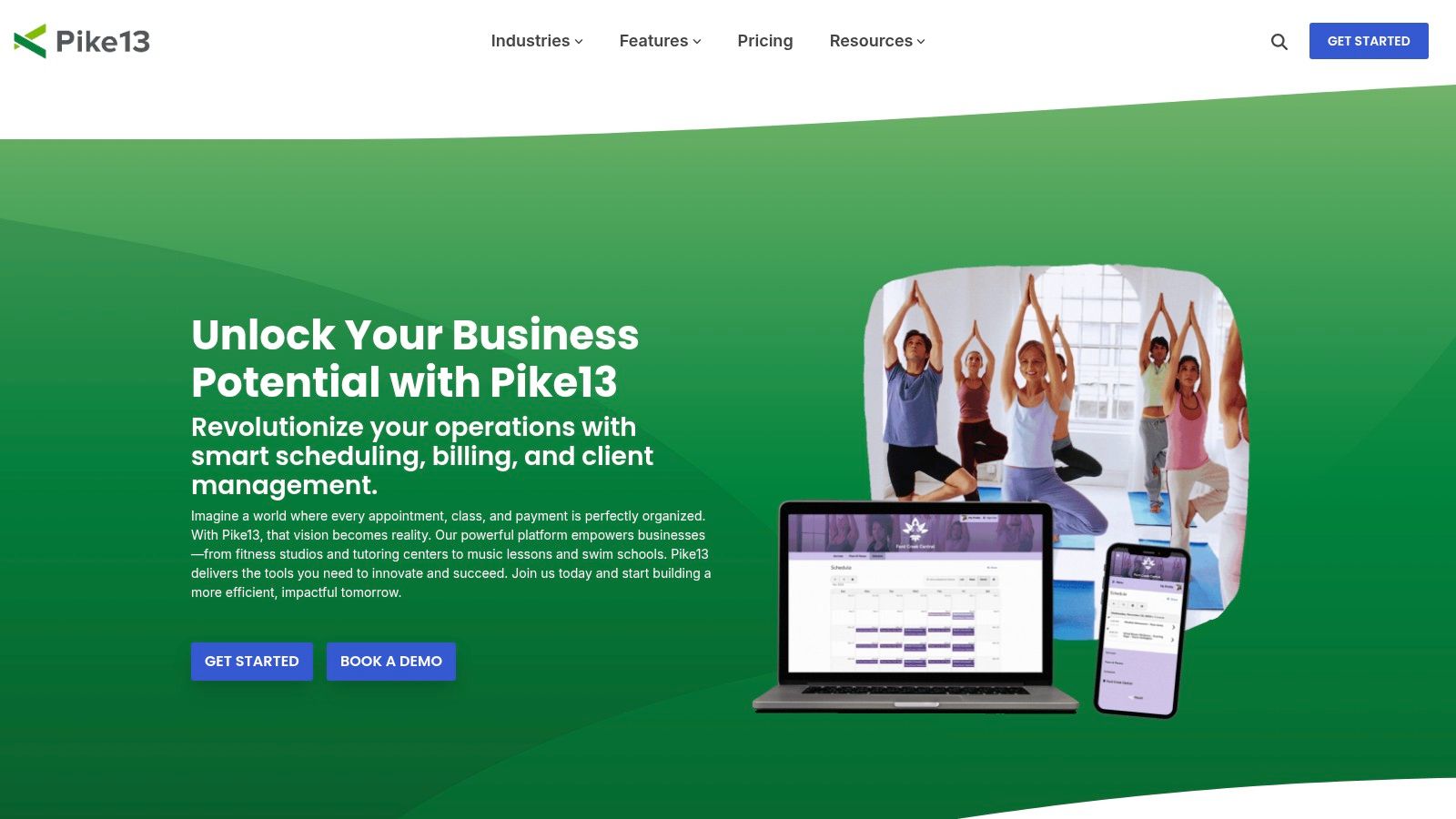
As an alternative to TutorCruncher, Pike13 appeals to education businesses that prioritize a polished client experience and brand presence. The availability of a branded app for clients and staff provides a professional touchpoint that many competitors lack. While not built exclusively for tutoring, its flexible architecture allows for significant customization to fit educational workflows, especially for businesses managing both private lessons and group classes across multiple sites.
Ideal For
Pike13 is best suited for established tutoring centers, music schools, and multi-service educational businesses that want to offer a premium, mobile-first experience to their clients. It’s a strong choice for organizations managing multiple locations that need consistent branding and operational control, a topic you can explore further with these insights on multi-location scheduling software on tutorbase.com.
Strengths & Weaknesses
Pros:
- Branded Mobile App: Offers a dedicated app for your business (at higher tiers), enhancing brand loyalty and simplifying client booking.
- Guided Onboarding: Provides structured onboarding and data migration services, easing the transition from other systems.
- Transparent Pricing: Features clear, publicly posted pricing plans, which helps in budgeting and decision-making.
Cons:
- Not Tutoring-Specific: The platform’s workflows are generalized for appointment-based services and may require adaptation for specific tutoring needs.
- Tier-Gated Features: Key tools, like advanced integrations and marketing automation, are often restricted to more expensive plans or require add-on fees.
Website: https://www.pike13.com/
10. Amilia (SmartRec)
Amilia, also known as SmartRec, is a robust management platform designed primarily for community recreation, after-school programs, and membership-based organizations. It excels at handling complex registrations, facility bookings, and point-of-sale transactions, making it a powerful tool for educational businesses that operate with a similar storefront or community center model. Its strength lies in its ability to manage multiple "stores" or programs under one umbrella.
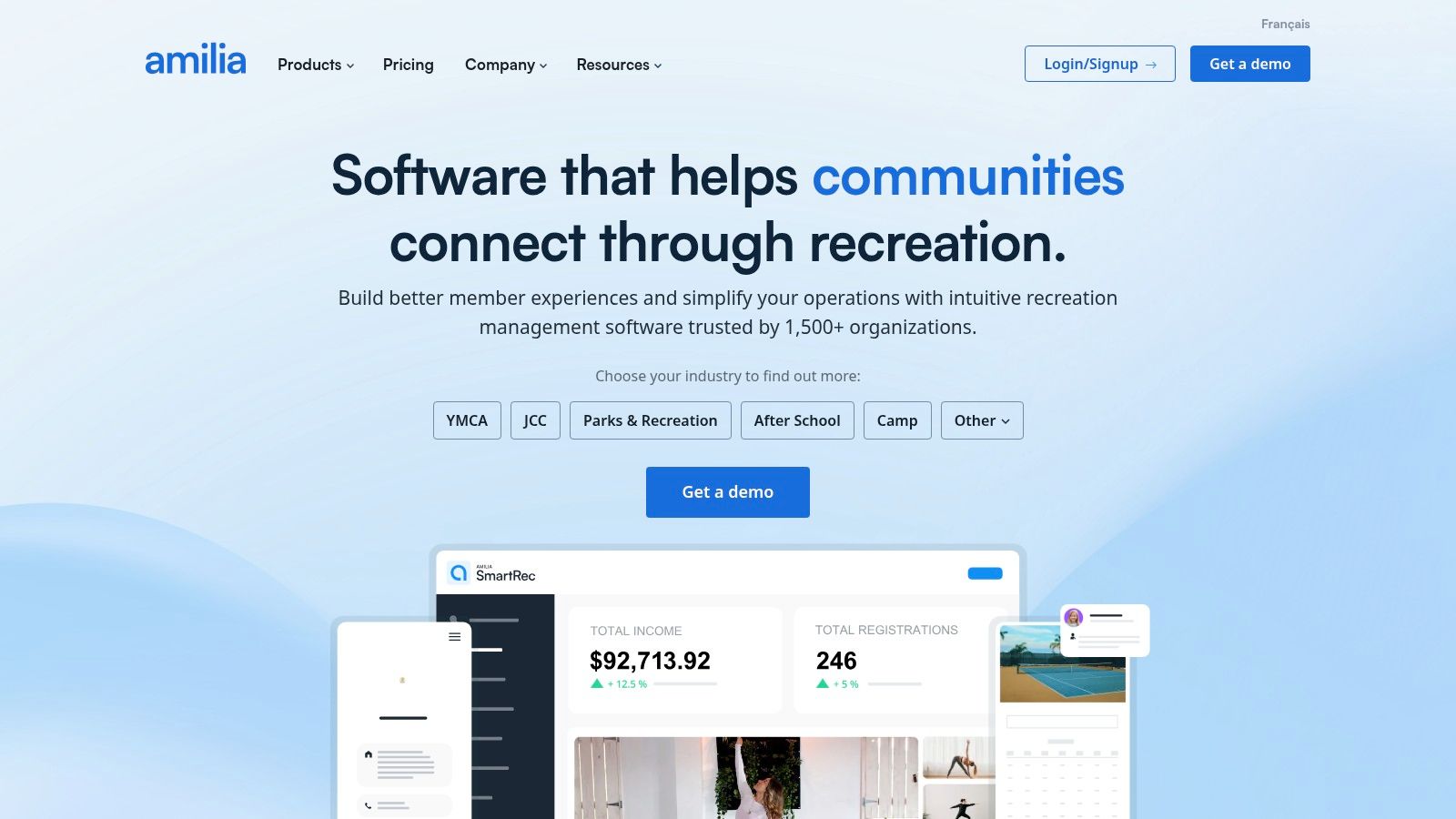
As an alternative to TutorCruncher, Amilia is a distinct choice for tutoring centers that also manage physical spaces, sell materials, or run camp-style programs. The platform's comprehensive facility and membership management tools go beyond what typical tutoring software offers. It allows businesses to manage room rentals, capacity controls, and recurring memberships with ease, centralizing both educational and operational revenue streams.
Ideal For
Amilia is best suited for larger, multi-faceted educational organizations like after-school program providers, community learning centers, and tutoring businesses that require integrated facility management and point-of-sale capabilities. Its multi-store functionality is perfect for franchises or multi-branch operations needing unified control.
Strengths & Weaknesses
Pros:
- Strong Facility Management: Superior tools for booking rooms, managing capacity, and scheduling resources across multiple locations.
- Integrated POS and e-Commerce: Manages program registrations, merchandise sales, and memberships through a unified online storefront.
- Scalable Plan Tiers: Offers clear pricing plans (Standard, Advanced, Custom) designed to grow with your business's scale and complexity.
Cons:
- Broad Focus: The platform is not purpose-built for tutoring, so some specific academic features may feel less refined or require workarounds.
- Higher Total Cost: Onboarding packages and processing fees can significantly increase the total cost of ownership beyond the base subscription price.
Website: https://www.amilia.com/
11. CourseStorm
CourseStorm is primarily a class registration software popular with community education, arts, and enrichment programs. While not a direct tutoring management system, it serves as a powerful alternative for businesses that prioritize a public-facing online catalog and simplified, student-led enrollment. It excels at making class discovery and sign-up incredibly easy for parents and students.

As one of the best alternatives to TutorCruncher for group-class-focused businesses, CourseStorm’s main advantage is its public course catalog and seamless registration flow. It is designed to reduce friction for new customers, allowing them to browse, register, and pay for multiple classes or family members in a single transaction. This makes it ideal for centers running seasonal camps, workshops, or after-school programs where marketing and easy sign-ups are key.
Ideal For
CourseStorm is best for community-based learning centers, after-school programs, and art or music schools that manage group classes with public enrollment. Its family account functionality makes it a strong choice for businesses catering to K-12 students where parents register multiple children at once.
Strengths & Weaknesses
Pros:
- Simple Public Catalog: Creates a clean, professional, and mobile-friendly website to showcase your classes and automate sign-ups.
- Family-Friendly Registration: Built-in family accounts simplify the process for parents enrolling multiple children or one child in several classes.
- Clear Pricing Tiers: The website has a very clear feature matrix, making it easy to compare plans and understand costs.
Cons:
- Per-Registration Fees: The model includes a per-registration fee (e.g., $2.49) on top of standard payment processing, which can add up for high-volume, low-cost classes.
- Limited Tutoring Features: Lacks the deep 1-on-1 scheduling, complex payroll, and individualized student management common in dedicated tutoring software.
- Advanced Features Gated: Key integrations and advanced reporting are often restricted to the highest-priced plans.
Website: https://www.coursestorm.com/
12. Jackrabbit Class
Jackrabbit Class is a powerful and widely-adopted management platform primarily designed for youth activity centers like gymnastics, dance, and swim schools. However, its robust feature set for recurring classes, complex family billing, and online registration makes it a strong contender for tutoring centers and after-school programs that operate on a similar class-based model rather than one-on-one appointments.
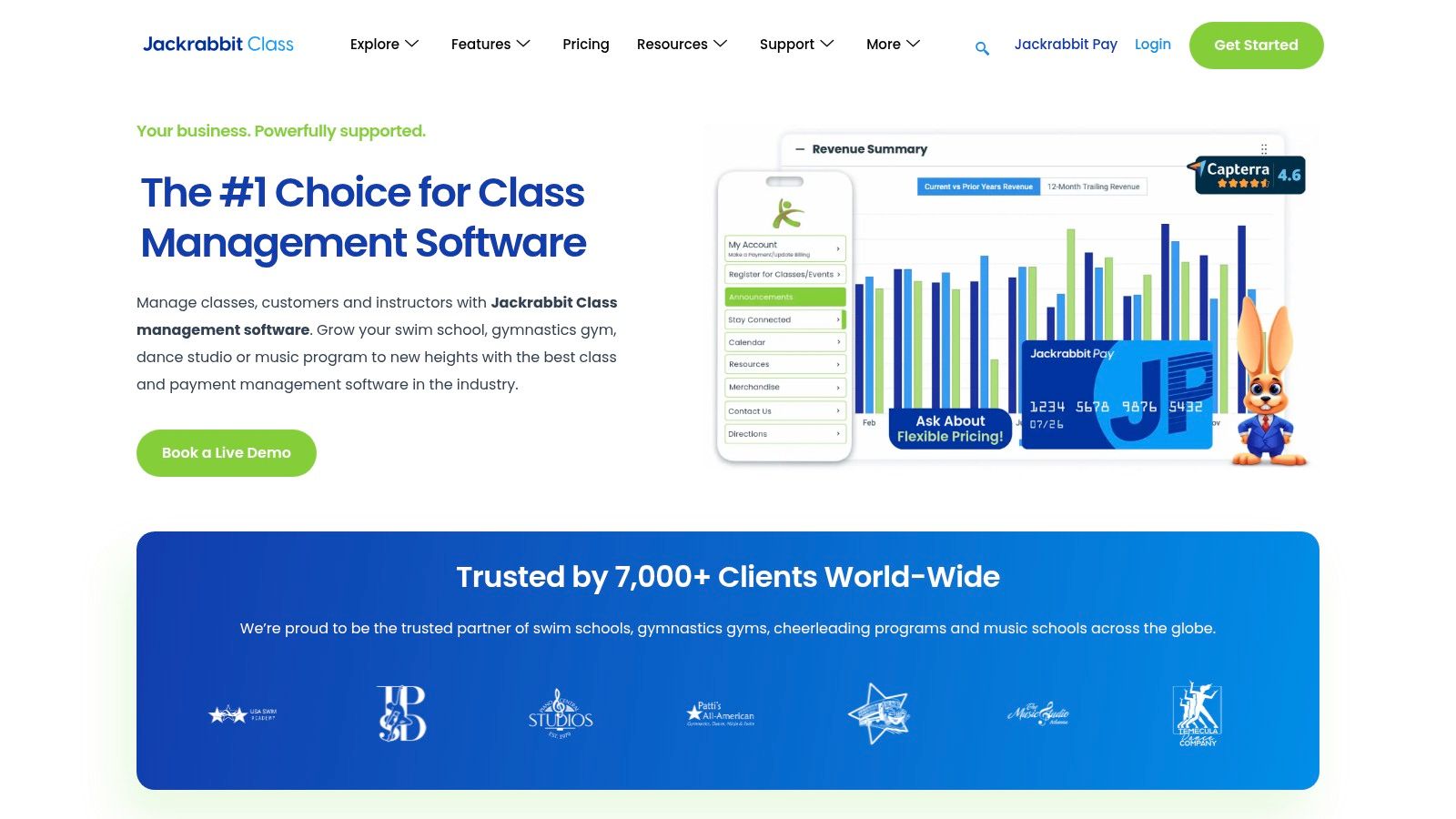
As an alternative to TutorCruncher, Jackrabbit Class excels in its ability to handle intricate tuition rules. Its system is built around managing families, not just individual students, with deep controls for multi-student discounts, multi-class discounts, proration, and automated fee schedules. The pricing is tiered transparently based on the number of active students, which is easy to understand and forecast.
Ideal For
This platform is a great match for medium to large academic centers, test-prep academies, and after-school programs (50-500+ students) that heavily rely on group classes with complex, recurring billing schedules. It’s particularly suitable for businesses managing multiple family members under a single account.
Strengths & Weaknesses
Pros:
- Deep Tuition Configuration: Offers extensive options for setting up discounts, prorating fees, and managing complex family billing rules automatically.
- Transparent Tiered Pricing: The pricing model based on student count is predictable and provides a clear upgrade path as your center grows.
- All-in-One Class Management: Includes features beyond tutoring, such as a Point of Sale system, time clock for staff, and skill tracking.
Cons:
- Generalized Terminology: The platform is built for youth activities, so academic centers may need to adapt to non-tutoring-specific language (e.g., "classes" instead of "lessons").
- Extra Cost for Branded App: The optional branded mobile app (Jackrabbit Plus) requires a one-time setup fee and an additional monthly subscription cost.
Website: https://www.jackrabbitclass.com/
Top 12 TutorCruncher Alternatives — Feature Comparison
| Product | Key strengths / USPs | Scheduling & rooms | Billing & payroll | Target customers & pricing |
|---|---|---|---|---|
| Tutorbase (Recommended) | AI scheduling (Find Slot/Spot); auto-billing from attendance; advanced payroll; WhatsApp lead widget; multi-branch & multi-brand | Conflict detection, recurring series, room capacity/fees, hybrid classes | Auto invoices from attendance, prepaid credits, flexible payroll (base+variable, revenue-share, overtime) | Tutoring centers & language schools (5–100+ teachers; 50–10k+ lessons/week); contact sales (no public tiers) |
| Teachworks | Mature, reliable core admin workflows; predictable cost model | Recurring lessons, attendance tracking, multi-location support | Invoicing, payments, payroll; per-lesson fee model | K‑12, test-prep, language schools; transparent pricing page; scales with volume |
| Teach ’n Go | All features included per plan; strong mobile app; multi-language support | Scheduling, attendance, student/parent mobile portal | Billing/invoicing, Stripe/PayPal, payroll | Language schools & centers; unlimited teachers on plans; EUR default pricing (toggle USD) |
| LearnSpeed | Transparent per-session pricing; integrated online tutoring; deep reporting | 1:1 & group scheduling, automated reminders | One-click invoicing, QuickBooks integration, session-based billing ($0.29/session) | Tutoring & test-prep companies; per-session pricing (may be higher for large groups) |
| TutorBird | Low-cost option for small teams; simple website builder & good basics | Calendar, attendance, two-way calendar sync | Auto-invoicing, online payments, late-fee automation | Solo tutors & small centers; low base price, 30-day trial & 90-day refund |
| Jumbula | Strong registration & seasonal enrollment tooling; pay-as-you-go option | Branded registration pages, rosters, check-in, family portal | Enrollment-based billing, coupons/discounts, add-on SMS/email | After-school programs, camps; flexible pay-as-you-go bundles; nonprofit discounts |
| Sawyer for Business (Hisawyer) | Marketplace reach and embedded checkout; consumer visibility | Class schedules, rosters, waitlists, payment plans | Embedded checkout with provider/platform booking fees (customer-facing fees) | After-school/activity providers; booking fees on orders ($1.99–$3.99 thresholds) |
| iClassPro | Strong POS, communications (SMS/voice) and reporting; per-location pricing | Class/camp bookings, customer portal, staff management | POS, payments, reporting, optional branded app | Activity schools (gymnastics, swim, dance); per-location plans; SMS credits extra |
| Pike13 | Transparent posted plans; guided onboarding; branded app option | Classes, courses, appointments, staff & client mobile apps | Billing, payroll, website widgets, analytics | Class- and appointment-based orgs; posted pricing; may need tutoring workflow tweaks |
| Amilia (SmartRec) | Facility & multi-store management; storefront-like control | Facility capacity controls, multi-store scheduling | POS, payments, reporting; add-on modules for advanced features | Recreation & activity centers; Standard/Advanced/Custom tiers; onboarding fees possible |
| CourseStorm | Clear tier matrix; family accounts & catalog website | Catalog listings, rosters, waitlists, transfers | Per-registration fee ($2.49) + payment processing | Community education, arts, enrichment programs; per-registration pricing model |
| Jackrabbit Class | Deep tuition, discount & proration controls; transparent tiers | Online registration, family portal, rosters | Tuition/fee rules, POS, time clock, optional branded app | Youth activity schools; tiered pricing by student count; enterprise options available |
Final Thoughts
Choosing the right tutoring management software is a pivotal decision. Moving from TutorCruncher or spreadsheets requires careful consideration of your business's core problems. This guide has detailed twelve of the best alternatives to TutorCruncher, each tailored to different operational needs, from solo tutors to multi-branch enterprises.
We've explored everything from the all-in-one power of Tutorbase and the streamlined efficiency of Teachworks, to the activity-specific features of platforms like Jackrabbit Class and iClassPro. The key takeaway is that the "best" choice directly solves your most pressing administrative bottlenecks and supports your specific growth trajectory.
Making Your Decision: Key Takeaways
Your final choice should hinge on a clear assessment of your business's current state and future goals.
- For Small but Growing Centers (5-20 teachers): Your primary concern is automating repetitive tasks like scheduling and invoicing. Look for platforms with intuitive interfaces and affordable, scalable pricing. Tools like TutorBird and Teach 'n Go offer strong foundational features that can save you countless hours.
- For Multi-Branch Operations (20-100+ teachers): You need centralized control with location-specific flexibility. Prioritize software with robust multi-branch management for rooms, teachers, and branding. Advanced payroll and reporting are non-negotiable. This is where a system like Tutorbase excels, offering granular control over a complex organization.
- For Specialized Academies (Test Prep, Language Schools): Your needs are specific, from curriculum and level management to complex package billing. Evaluate how each alternative handles the nuances of your service delivery, like managing both group classes and one-on-one sessions with different pricing rules.
Your Next Steps: From Analysis to Action
Before committing to a new system, create a detailed migration plan.
- Define Your Must-Haves: List the top 3-5 administrative problems you need to solve. Is it payroll complexity? Is it booking errors? This list is your North Star.
- Engage Your Team: Involve your key administrative staff and a few tech-savvy teachers in the demo process. Their buy-in is crucial for a smooth transition.
- Run a Pilot: Before a full-scale migration, test your top choice with a small group of students and teachers for a month. This real-world trial will uncover any friction points and validate your decision.
Ultimately, selecting a management platform is a strategic business decision. The right tool frees up administrative time, provides critical business insights, and creates a better experience for your staff, students, and parents. Just as businesses in other sectors use the best tools for strategic analysis to understand their market, investing in the right operational software gives your tutoring center the competitive edge it needs to thrive. The goal is to spend less time managing your business and more time growing it.
FAQ: Choosing a TutorCruncher Alternative
What is the best alternative to TutorCruncher for a multi-location tutoring center?
For multi-location centers, the best alternative is a platform with strong centralized management features. Tutorbase is designed specifically for this, offering multi-branch room scheduling, teacher management, and even multi-brand support from a single dashboard. This allows you to standardize operations while managing location-specific details.
How can I automate invoicing for my tutoring business?
Most modern tutoring management software automates invoicing. A system like Tutorbase generates invoices directly from lesson attendance records. This means once a teacher marks a lesson as "Attended," the system automatically creates the corresponding charge, eliminating manual data entry and ensuring billing accuracy.
Are there any TutorCruncher alternatives with advanced payroll features?
Yes. While many platforms offer basic hourly payroll, some provide more advanced options. Tutorbase features a complex payroll engine that supports per-hour, per-lesson, revenue share, and base + variable compensation models, as well as premiums for weekends or specific subjects. This is critical for centers with diverse teacher contracts.
What should I look for in a tutor scheduling software?
Look for conflict detection to prevent double-bookings, recurring lesson creation, and calendar views with robust filtering (by teacher, location, or subject). For maximum efficiency, an AI-powered scheduler like Tutorbase’s "Find Slot" can automatically find optimal time, teacher, and room combinations, reducing booking time significantly.
Can these alternatives manage both online and in-person tutoring?
Yes, many modern platforms support hybrid operations. Look for features that allow you to designate a lesson's delivery mode (online, in-person) and even track attendance for individual students differently within the same hybrid class. This flexibility is essential for centers offering multiple learning formats.
How do I migrate my data from TutorCruncher to a new system?
Most reputable software providers offer guided onboarding and data migration services. The process typically involves exporting your student, teacher, and scheduling data from TutorCruncher into a standard format (like CSV) and then working with the new provider's support team to import it into their system. Always run a small pilot test first.
Ready to eliminate administrative chaos and see a 60% reduction in admin time? Tutorbase was built by tutoring center owners to solve the exact challenges discussed in this article, from AI-powered scheduling to complex payroll. Discover why it’s a leading alternative to TutorCruncher for scaling businesses.


