


Key Takeaway: The right tuition center software in Malaysia automates your daily operations, from scheduling and billing to parent communication. By replacing messy spreadsheets, these systems eliminate costly errors, slash admin hours, and provide the multi-branch management needed to scale your business across the country.
If you run a tuition centre in Malaysia, you've probably hit a wall with spreadsheets. They work at the start, but as you grow, they become a mess of scheduling conflicts, missed invoices, and endless admin work. Specialised tuition center software solves this by automating your most time-consuming tasks.
Think of it as the central nervous system for your business. It provides a solid foundation that lets you scale your operations without drowning your team in paperwork, offering a proven alternative to manual methods and legacy systems like Teachworks.
Your Guide to Tuition Center Software in Malaysia
This guide focuses on what works specifically for the Malaysian market. We'll examine how the right system handles local needs, like dominant WhatsApp communication and multi-currency support for international students. Getting this right is about future-proofing your centre for sustainable growth in 2026 and beyond.
To see where the industry is heading, our guide on tutoring management software in 2026 offers a glimpse into upcoming trends. But for now, let’s build your operational playbook for sustainable growth right here at home.
The Hidden Costs of Manual Administration
Many tuition centres in Malaysia use a patchwork of familiar tools. You have spreadsheets for payments, Google Calendars for schedules, and WhatsApp groups for parent updates. This DIY approach seems free, but it has hidden costs that quietly drain your centre of time and money.
This manual system is a bottleneck waiting to happen. Picture the chaos during SPM prep season when your star tutor is double-booked. Or the admin hours spent chasing parents for late fees, a task that frays relationships and stalls your cash flow.
How much time is lost to repetitive tasks?
The most obvious cost is time. Your administrative staff spend their days on repetitive work instead of activities that grow the business, like talking to prospective parents. Productivity studies show automating these chores can free up as much as 70% of an administrator's time.
Just think about these common time sinks:
- Manual Invoicing: Creating, sending, and chasing individual invoices every single month.
- Payment Reconciliation: Matching bank transfer receipts to names on a spreadsheet.
- Schedule Coordination: Endless back-and-forth on WhatsApp to align tutor availability and room bookings.
- Payroll Calculation: Manually tallying teacher hours from messy attendance sheets, a process ripe for mistakes.
What is the financial impact of human error?
Manual processes lead to human errors with a direct financial impact. A slip-up in a spreadsheet could mean under-billing a family for an entire month. A scheduling mix-up can lead to a cancelled class, lost revenue, and an unhappy parent.
A 2023 study from the HK Federation of Education Workers found that centres relying on spreadsheets faced payroll errors costing them 8-10% of their total teacher payout budget each year. For a mid-sized centre, that can easily add up to thousands of Ringgit in preventable losses.
How do manual systems limit growth?
The biggest hidden cost is opportunity cost. Your spreadsheet system might cope with 50 students, but it will break when you try to scale to 150. A system built on WhatsApp and Excel cannot support a multi-branch operation or handle a sudden surge in enrolment.
It’s time for a frank comparison between the old way and the smart way. One path leads to constant firefighting, while the other paves the way for smooth scaling.
Manual Admin vs. Automated Software: A Comparison
| Administrative Task | Manual Method (Spreadsheets & WhatsApp) | Automated Method (Tuition Centre Software) |
|---|---|---|
| Scheduling | High risk of double-bookings; hours spent coordinating. | Centralised calendar with conflict detection; instant booking. |
| Billing | Time-consuming manual creation; frequent follow-ups. | Automatic invoice generation from attendance records. |
| Reporting | Difficult to generate insights; data is often outdated. | Real-time dashboards on revenue, attendance, and growth. |
| Scalability | Becomes unmanageable with growth; error rates increase. | Easily handles multiple branches and thousands of students. |
Clinging to manual methods places an artificial ceiling on your centre's potential. Moving to a proper management system isn't just about efficiency; it's a strategic move to unlock your future success.
What Features Should Malaysian Tuition Centres Actually Look For?
When you shop for tuition centre software in Malaysia, it is easy to get lost in feature lists. The best platforms are built with a deep understanding of the local market. They automate the exact tasks that consume your time and energy.
You need tools that handle the day-to-day chaos. Think intelligent scheduling that prevents double bookings, billing that connects with local payment gateways, and multi-branch management that lets you grow without breaking a sweat.
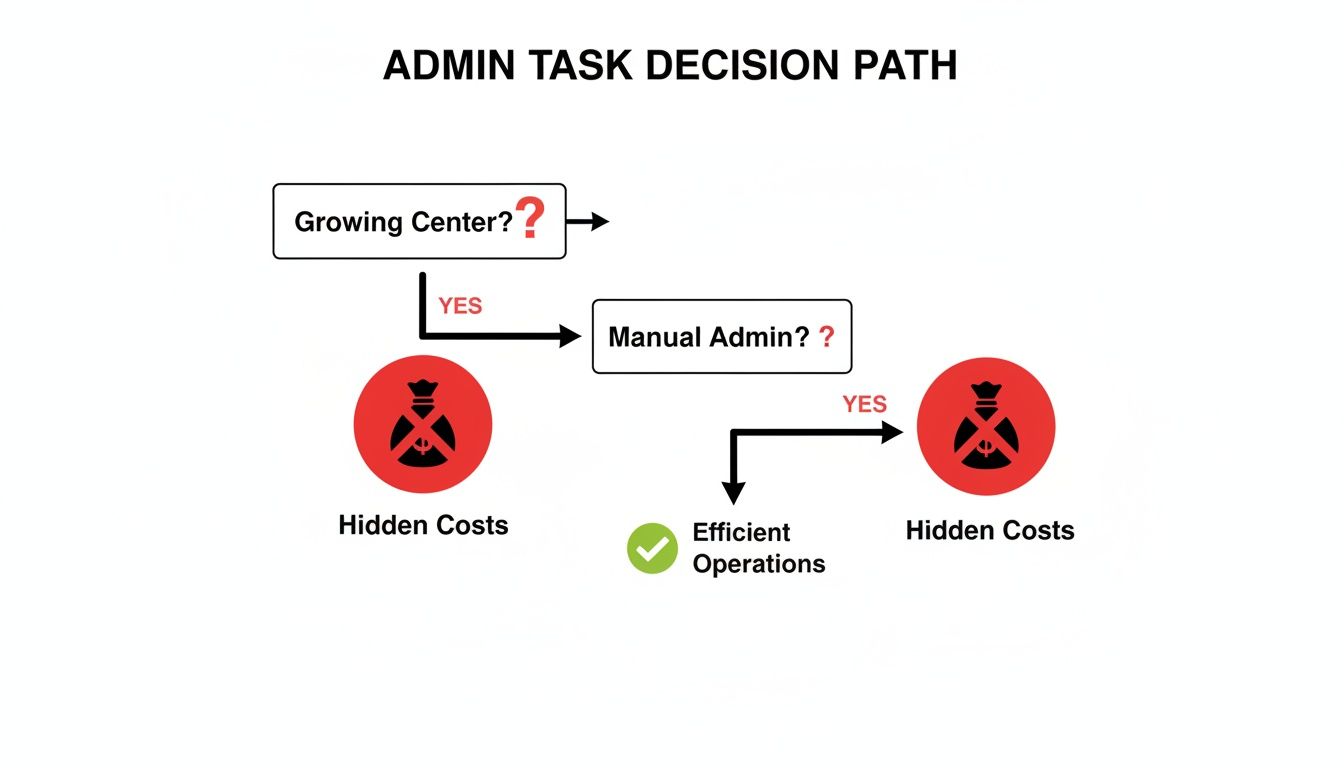
The flowchart above maps out a familiar story for many growing centres. The more you rely on manual processes, the more you leak money and create operational bottlenecks that stop you from expanding.
What is Multi-Branch Management?
Multi-branch management provides a single dashboard to run all your locations. Instead of juggling separate logins for your KL, Penang, and JB branches, you get one clear view of performance, schedules, and payments across the entire business.
This central control is crucial for anyone serious about expansion. It guarantees that whether a student signs up in Subang Jaya or Johor Bahru, they get the same professional, seamless experience. This is a core feature in systems proven in demanding markets like Hong Kong and Singapore.
How do I automate tutor scheduling?
Your timetable is the engine of your tuition centre. Intelligent scheduling tools make mistakes like double-bookings impossible. Good tuition centre software in Malaysia finds the perfect slot based on tutor availability, room capacity, and student needs, all automatically. This feature alone can save you hours each week.
- Conflict Detection: The system instantly flags and prevents you from scheduling a tutor in two places at once.
- Resource Allocation: It checks for an available classroom of the right size before the booking is confirmed.
- Complex Rotations: It handles recurring weekly classes, holiday breaks, and last-minute swaps without creating a mess.
To get into the details of optimising your timetables, check out our complete tutor scheduling software guide.
Can software handle local Malaysian payments?
Yes, and this is a critical feature. Automation changes the game by linking attendance directly to invoicing. A tutor marks a student as present, and the system instantly generates and sends the invoice, ensuring accuracy and timeliness.
Crucially for Malaysian centres, the software must support local payment methods. Integrating with gateways popular in Malaysia, like FPX or e-wallets, can increase on-time payments by over 40%. This simple feature dramatically improves cash flow.
Your system should also handle any billing model:
- Pre-paid credit packages
- Monthly subscription fees
- Pay-per-lesson charges
- Family discounts and sibling rates
Why is WhatsApp Integration so important in Malaysia?
In Malaysia, WhatsApp is how families communicate. A 2023 report from the Malaysian Communications and Multimedia Commission (MCMC) found that 97% of internet users here use it. Any software that ignores this is out of touch.
The best systems integrate directly with WhatsApp. This lets your centre send automated reminders, payment alerts, and class updates without an admin manually typing messages. It keeps parents in the loop and massively reduces no-shows.
How to Compare Software Options for Your Centre
When you look at different options, compare them side-by-side. Focus on how each feature solves a real-world problem for your Malaysian centre. Modern software is built for the specific challenges of scaling in the local market.
| Feature | Spreadsheets | Legacy Systems (e.g., Teachworks) | Modern Software (e.g., Tutorbase) |
|---|---|---|---|
| Multi-Branch View | Impossible; needs separate files. | Basic, often clumsy. | Centralised dashboard for all locations. |
| WhatsApp Integration | Not available; fully manual. | None; relies on email. | Built-in automated notifications. |
| Timezone Support | Manual tracking needed. | Limited or non-existent. | Automatic handling for Malaysia. |
| Multi-Currency | Difficult and error-prone. | Basic functionality. | Native support for MYR, SGD, etc. |
Beyond admin, modern tuition software often includes tools for attracting and keeping students. Understanding effective CRM tools and lead management strategies is a must. The best systems build these capabilities in, helping you manage potential students from their first call.
How Automation Directly Impacts Your Bottom Line
Implementing tuition centre software is a direct financial strategy, not just an operational tweak. Automation slashes admin hours, eliminates costly human errors in scheduling and payroll, and improves your cash flow. For Malaysian centres, it delivers a clear return on investment that fuels growth.
Investing in a tuition center software malaysia platform turns features into tangible money. When you move from spreadsheets to an automated system, you can put a ringgit value on the impact. It shows up as concrete numbers on your balance sheet.
Let's use a realistic example: "Cerdik Academy," a mid-sized tuition centre in Kuala Lumpur. Before switching, their operations manager spent nearly 15 hours a week juggling schedules, creating invoices, and chasing payments via WhatsApp.
What is the true cost of manual work?
The financial drain of manual work is easy to underestimate. For Cerdik Academy, the damage came from constant, low-level financial leaks. These small mistakes compounded over time and actively held back their growth.
This story is incredibly common. In Hong Kong's tutoring sector, where 65% of centres still use spreadsheets, payroll errors cost them 8-10% of their teacher payouts each year. You can explore similar industry challenges in this report on the online education market in Malaysia.
- Scheduling Errors: Double-booking a tutor meant refunding parents and losing revenue from the cancelled class.
- Billing Mistakes: Accidentally under-billing a student went unnoticed for months, leading to lost income.
- Delayed Payments: Manually chasing invoices created unpredictable cash flow, making it difficult to budget for expansion.
How do you quantify the return on investment?
After implementing a modern management system, Cerdik Academy’s transformation was immediate and measurable. The software automated the most time-consuming tasks, freeing their manager to focus on high-value work like marketing and parent engagement.
Here’s a breakdown of their financial wins:
- Admin Time Slashed: The manager's admin workload plummeted from 15 hours to just 6 hours per week, a 60% reduction. This saved the centre RM 1,500 per month in productive time.
- Errors Eliminated: Scheduling conflicts and billing mistakes dropped to zero. This stopped an estimated RM 800 per month from leaking out due to refunds and unbilled classes.
- Cash Flow Stabilised: With automated invoicing and online payments, 85% of fees were paid within three days, a massive jump from the previous 40%.
A Case Study in Financial Health
Let's put the numbers side-by-side. This shows the real-world impact of moving from spreadsheets to a dedicated tuition center software solution.
| Metric | Before Automation (Manual) | After Automation (Software) | Monthly Impact |
|---|---|---|---|
| Admin Hours/Week | 15 Hours | 6 Hours | 9 Hours Saved |
| Revenue Lost to Errors | ~ RM 800/month | RM 0/month | RM 800 Saved |
| On-Time Payments | 40% | 85% | 45% Increase |
| Monthly ROI | - | - | ~ RM 2,300+ |
By automating their core operations, Cerdik Academy unlocked their staff's potential. This newfound capacity allowed them to launch a new SPM intensive programme, growing their student base by 20% in six months without hiring new admin staff.
Choosing the Right Software for Growth in 2026
Choosing your software is a strategic choice that will either fuel your growth or become a bottleneck. If your current system feels like it’s holding you back, you are not alone. Many legacy systems were not designed for the multi-branch reality of a modern Malaysian education business.
A system that works for 50 students can become a nightmare at 200. You should choose a platform built not for where you are today, but for where you plan to be in 2026. This forward-thinking choice saves you from the painful process of migrating systems every few years.
Why do legacy systems fail to scale?
The gap between old software and a modern platform is massive. Legacy systems often treat core functions like separate modules. This forces you to manually connect a student's attendance, their invoice, and their tutor's payroll. It’s disjointed by design.
Modern platforms weave these functions into one seamless, automated workflow. In Hong Kong’s competitive HKD 4.3 billion private tuition industry, centre owners with outdated methods report a 25% rate of double-booking errors. You cannot afford those mistakes.
Software Feature Comparison for Malaysian Centres
When you review tuition centre software in Malaysia, the real test is how features support growth. This means scaling across states, handling local payments, and using communication channels that Malaysian parents actually use.
Here’s a breakdown of how different solutions stack up.
| Feature | Spreadsheets | Legacy Software (e.g., Teachworks) | Modern Platform (e.g., Tutorbase) |
|---|---|---|---|
| User Interface | Functional but clunky | Outdated, requires extensive training | Intuitive, designed for fast onboarding |
| Multi-Branch Control | Requires separate files per location. | Basic, lacks true central reporting | Seamless central dashboard for all locations |
| Billing Flexibility | Completely manual calculations | Rigid, struggles with custom plans | Fully automated for credits, subscriptions, etc. |
| WhatsApp Integration | Non-existent | Relies on email and SMS | Built-in for automated reminders & comms |
| Timezone Support | Manual tracking needed | Limited to non-existent | Automatic handling for Malaysia |
What starts as a "free" solution quickly costs you in time and missed opportunities. Modern platforms are built to solve the operational headaches that come with scaling a tuition business in a market like Malaysia.
Why does an intuitive user experience matter?
An intuitive user interface (UI) is about efficiency, not just looks. A confusing system means longer staff training, slower daily tasks, and a higher chance of human error. A clean, modern UI means your team can work faster and with more confidence.
Here's a simple test: Can a new admin book a trial class and process an enrolment within their first hour? With a modern system, the answer should be "yes." For more tips, this guide on how to choose an LMS offers a solid framework.
How to Make a Smooth Switch to Your New System
Moving to new tuition centre software feels like a massive project, but a structured plan makes all the difference. The keys are preparing your data, keeping everyone informed, and training your team. A solid plan ensures a smooth transition with minimal disruption.

Ditching old spreadsheets or a clunky system is a huge step toward growth. The goal is to upgrade how you run things behind the scenes. With the right strategy, you can sidestep headaches and get your new system adopted successfully from day one.
Step 1: How do you prepare data for migration?
First, you need to get your existing data ready. This is the most crucial phase because clean, organised data ensures your new tuition centre software Malaysia works perfectly. Think of it as a digital spring clean for your records.
Start by exporting essential info like student profiles, contact details, and payment records.
- Standardise Naming Conventions: Ensure all names and addresses follow a consistent format.
- Remove Duplicate Entries: Get rid of duplicate student or parent profiles.
- Update Contact Information: Double-check that all phone numbers and emails are current.
- Archive Old Records: Decide what historical data is essential to bring over.
Step 2: How should you configure the new system?
Once your data is clean, set up the new software to mirror how your centre operates. This is where you tailor the platform's settings to match your rules for billing and scheduling. You make the system work for you.
Modern software proven in markets like Hong Kong and Singapore offers deep customisation. You can set rules for timezone support across Malaysian states or handle multiple currencies. A well-configured system becomes your digital rulebook.
Key setup tasks include:
- Defining Billing Cycles: Set up your rules for monthly, termly, or package-based invoicing.
- Setting Tutor Pay Rates: Input specific contract terms for each tutor to automate payroll calculations.
- Establishing Communication Templates: Customise your automated WhatsApp and email reminders.
Step 3: What's the best way to train staff and communicate with parents?
A new tool is only as good as the people using it. A proper training plan is non-negotiable to ensure your team feels confident with the new system. Schedule dedicated sessions that walk them through the core functions they will use daily.
At the same time, let parents know what's coming. Clear, proactive communication prevents confusion. Explain the benefits they'll get, like a new online portal for payments or easier access to their child's schedule.
Frequently Asked Questions (FAQ)
How much does tuition center software cost in Malaysia?
The price of tuition center software in Malaysia typically depends on your centre's size. Most modern platforms use a subscription model based on the number of active students or staff, so you only pay for what you use. This makes powerful tools accessible without a large upfront investment.
Can this software handle multiple branches across different states?
Yes, multi-branch management is a core feature of modern tuition software. You can manage all your branches, from Kuala Lumpur to Penang, from a single dashboard. A good system will include timezone support to keep schedules accurate across Peninsular Malaysia, Sabah, and Sarawak.
Is my student and financial data secure?
Reputable tuition software providers use secure, cloud-based servers with data encryption and automatic backups. This is far more secure than storing sensitive information in spreadsheets on a local computer, protecting you from data loss due to theft, hardware failure, or human error.
How long does it take to switch to a new system?
With a clear plan, you can switch to a new system in just a few weeks. The timeline depends on how clean your existing data is. The process involves three main stages: data cleanup, system setup, and team training. A good software partner will guide you through each step.
What kind of support is available for Malaysian centres?
Look for a provider that offers support during local business hours. The best platforms provide online help guides, video tutorials, and direct help via email or chat. Support that understands the local context, like the importance of WhatsApp, is essential for getting relevant and effective help.
Can the software integrate with WhatsApp?
Yes, and you should not settle for a system that doesn't. Direct WhatsApp integration is a must-have for sending automated class reminders, payment alerts, and schedule updates to Malaysian parents. This feature saves your admin team dozens of hours and significantly reduces student no-shows.
Ready to replace spreadsheet chaos with streamlined control? Tutorbase provides the intelligent scheduling, automated billing, and multi-branch management that Malaysian tuition centres need to scale efficiently. See how it works by registering for an account at tutorbase.com/register.


